How Technology Is Reshaping the Way Spine Care Is Planned: Insights from Dr. Larry Davidson
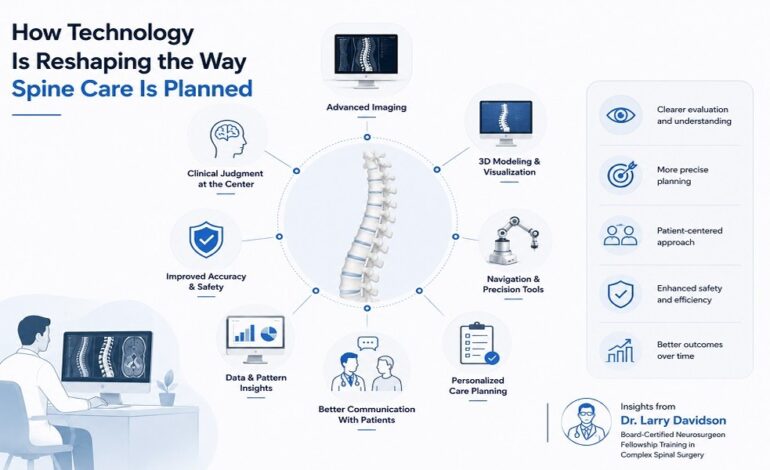

Planning for spine care has become more detailed over time, shaped by advances in imaging, data interpretation, and procedural tools. While clinical evaluation remains central, technology now plays a more defined role in helping physicians understand conditions with greater clarity. These tools do not replace experience or judgment but provide additional layers of information that help refine how decisions are made. Dr. Larry Davidson, a board-certified neurosurgeon with fellowship training in complex spinal surgery, often considers how these advancements contribute to a more structured and informed planning process.
Technology’s role has extended beyond the operating room. These days, it begins during evaluation, where information from imaging, clinical examination, and patient history is brought together to form a more complete picture. By enhancing how these elements connect, technology supports a clearer understanding of both the condition and how different treatment approaches may be considered within that context.
Imaging as the Foundation of Planning
Advanced imaging technologies such as MRI and CT scans form the foundation of modern spine care planning. These tools provide a detailed visualization of spinal structures, including discs, nerves, and surrounding tissues, allowing physicians to identify potential sources of symptoms with a higher level of precision.
At the same time, imaging must be interpreted carefully and thoughtfully. Structural findings are common and do not always correspond directly to what a patient is experiencing. That is why imaging is most useful when it is evaluated alongside symptoms and functional changes, helping determine whether what is seen on a scan is actually relevant to the patient’s condition.
Moving Beyond Basic Visualization
Modern imaging has advanced beyond simple structural views. High-resolution scans and multi-planar imaging allow physicians to examine the spine from multiple angles, providing a more comprehensive understanding of how different structures interact.
This additional detail can reveal relationships that may not be apparent in standard imaging alone. Subtle narrowing around a nerve, early changes in alignment or small variations in disc structure can become more visible. These insights help refine the interpretation of findings and contribute to more precise planning.
Using Data to Recognize Patterns
Technology also supports planning through the use of data and pattern recognition. By analyzing trends in symptoms, imaging findings and treatment responses, physicians can gain a broader perspective on how certain conditions typically behave.
These patterns provide context rather than conclusions. They help frame expectations and guide initial thinking, allowing physicians to approach each case with a more informed perspective. This data-driven insight complements clinical judgment and supports more consistent evaluation.
Technology in Preoperative Planning
When surgery becomes part of the treatment pathway, technology plays a more direct role in planning. Tools such as digital modeling, navigation systems, and preoperative simulations allow for a more structured and detailed approach.
These systems help visualize the procedure in advance, offering a clearer understanding of anatomy and potential challenges. By mapping out key steps ahead of time, surgeons can refine their approach, which contributes to greater precision and efficiency during the procedure itself.
Maintaining the Role of Clinical Judgment
Despite the increasing role of technology, clinical judgment remains central to spine care planning. Technology provides information, but it does not determine how that information should be applied. The value of these tools depends on how effectively they are interpreted within the broader clinical context.
Dr. Larry Davidson emphasizes that technology is most effective when it supports clinical reasoning rather than replacing it. The interpretation of findings, the understanding of symptom patterns, and the consideration of patient-specific factors all rely on experience and expertise.
Improving Communication with Patients
Technology has also changed how physicians communicate with patients. Imaging and visual tools can help explain complex conditions in a way that is easier to understand, making discussions more productive and informative.
When patients can see and better understand what is happening within the spine, they are more likely to engage in meaningful conversations about their care. This improved communication helps align expectations and supports more informed decision-making.
Supporting More Individualized Care
With more detailed information available, care plans can be tailored more closely to the individual. Technology allows physicians to move beyond generalized approaches and focus on how a condition presents in a specific patient.
This level of personalization helps make sure that treatment decisions reflect both clinical findings and individual needs. It reinforces the importance of adapting care to the patient rather than applying a one-size-fits-all approach.
Recognizing the Limits of Technology
Even with its advantages, technology has limitations that must be considered. Imaging findings may not always explain symptoms, and data cannot fully capture how a condition affects daily life or function. These gaps highlight the importance of looking beyond what is visible on a screen.
Understanding these limits is essential for maintaining balance in the evaluation process. It reinforces the importance of integrating technological insight with clinical observation and patient experience to form a more complete understanding.
Integrating Tools with Experience
The most effective planning occurs when technology is combined with clinical expertise. Imaging, data, and procedural tools provide valuable information, but their impact depends on how they are interpreted and applied. This combination allows for a more thoughtful approach that considers both precision and context.
By integrating these elements, physicians can develop a more comprehensive understanding of the condition. This approach supports decisions that are informed by both detailed analysis and practical experience. It also helps treatment plans align with how the condition is present in everyday life.
A More Structured Approach to Planning
Technology has contributed to a more structured approach to spine care planning. By providing clearer information and supporting more detailed analysis, it helps create a process that is both systematic and adaptable. This structure allows for more consistent evaluation while still accommodating the nuances of each case.
At the same time, this process remains centered on the patient. By combining technological insight with clinical judgment and patient experience, spine care planning becomes more precise while still reflecting the complexity of each case.